Discounted Drugs, Premium Profits: How the 340B Program Became a Windfall for Hospital Executives and a War Zone for Big Pharma — While Poor Patients Wait

A Program Built on a Promise
In 1992, Congress created the 340B Drug Pricing Program with a straightforward mandate: allow hospitals serving disproportionately low-income populations to buy outpatient drugs from manufacturers at significantly reduced prices — discounts that can reach 25 to 50 percent below market rates — and use the resulting savings to extend and deepen care for vulnerable patients. The logic was sound. Safety-net institutions operate on thin margins. Pharmaceutical costs are substantial. A pricing break at the point of purchase, passed through to the communities these hospitals serve, could meaningfully expand access.
For a period, the program worked roughly as intended. But as 340B has grown into a $54 billion program by some industry estimates — a figure reflecting the spread between discounted acquisition costs and reimbursement rates — the incentive structure has shifted in ways that should alarm anyone who cares about healthcare equity. What began as a targeted subsidy for genuine safety-net providers has become, in the hands of large and increasingly profitable hospital systems, something closer to a revenue optimization strategy. And the drug manufacturers, watching billions flow to institutions they argue are no longer the program's intended beneficiaries, have launched a legal and regulatory offensive that threatens to eliminate the discounts even for the hospitals and clinics that genuinely need them.
The patients caught in the middle are, as is so often the case in American healthcare, the ones with the least power and the fewest alternatives.
How Hospitals Captured the Benefit
The 340B program's eligibility criteria center on a hospital's "disproportionate share" status — a federal designation tied to the share of low-income patients served, measured by Medicaid and low-income Medicare utilization rates. The threshold is not especially high. A hospital serving a relatively modest share of low-income patients can qualify, and once qualified, it can extend 340B pricing to a network of affiliated outpatient clinics — including facilities located in wealthy suburbs, far from any reasonable definition of a safety-net mission.
This geographic and institutional expansion has been dramatic. According to federal data and reporting by outlets including the Wall Street Journal and Health Affairs, the number of 340B-covered entities and their affiliated sites has grown substantially over the past two decades, with many of the new participants being large, financially robust health systems rather than the community health centers and rural clinics the program was originally designed to prioritize. A 2018 report from the Government Accountability Office found that 340B hospitals were not consistently providing more charity care than non-340B hospitals — a finding that cut directly against the program's foundational justification.
The financial mechanics are significant. A 340B-eligible hospital purchases a drug at the discounted price, then bills Medicare, Medicaid, or a private insurer at the standard reimbursement rate. The spread between those two figures — sometimes called the 340B margin — flows to the hospital. Federal law does not require hospitals to document how those funds are used, and there is no enforceable obligation to pass savings to patients in the form of lower out-of-pocket costs, expanded charity care, or enhanced services for low-income populations. Many hospitals do reinvest in mission-driven programs. Many others do not, and there is no federal mechanism to distinguish between the two.
The Pharmaceutical Counterattack
Pharmaceutical manufacturers, observing the program's expansion and the profits being generated by large hospital systems, began restricting 340B discounts in 2020 and 2021 — particularly for drugs dispensed through contract pharmacies, which allow 340B-eligible hospitals to extend discounted drug access through retail pharmacy partnerships. Manufacturers including AstraZeneca, Eli Lilly, and others argued that contract pharmacy arrangements facilitated "duplicate discounts" and program abuse, and moved unilaterally to limit or condition access.
The Biden administration and the Health Resources and Services Administration (HRSA) pushed back, issuing advisory opinions asserting that manufacturers were legally obligated to provide 340B pricing regardless of dispensing arrangement. The legal battle that followed produced a fractured landscape of federal court rulings, with some circuits siding with manufacturers and others with the government. The Supreme Court's 2022 decision in American Hospital Association v. Becerra — which addressed a related but distinct question about Medicare reimbursement rates for 340B drugs — added further complexity without resolving the contract pharmacy dispute.
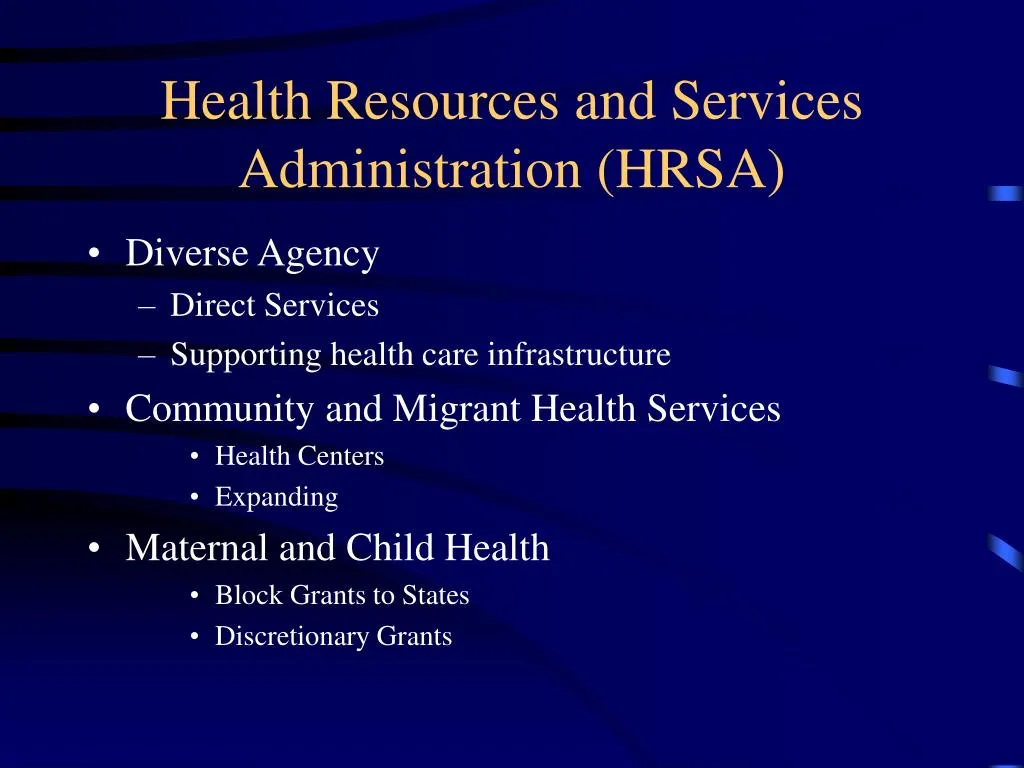 Photo: Health Resources and Services Administration, via image.slideserve.com
The manufacturers' argument has a surface plausibility: if large, profitable hospital systems are capturing 340B margins without demonstrably serving the program's intended population, why should pharmaceutical companies be required to subsidize that arrangement? It is a reasonable question that points to a real problem. The answer, however, is not to eliminate the discounts. It is to fix the program's accountability architecture — because gutting 340B entirely would devastate the community health centers, Ryan White HIV/AIDS clinics, and federally qualified health centers that depend on it to remain financially viable and to provide genuinely low-cost or free medications to patients who cannot afford market prices.
The Strongest Version of the Other Side
Hospital associations argue that 340B revenue cross-subsidizes services that would otherwise be financially unsustainable — trauma centers, psychiatric units, burn wards, and outreach programs that serve low-income communities but generate little or no margin. This argument is not without merit. American hospital financing is genuinely complex, and the implicit cross-subsidization that makes safety-net services possible is real. Eliminating 340B revenue without replacing it through direct federal support would cause genuine harm in some institutions.
But this argument, even at its strongest, does not justify the absence of transparency or accountability. If 340B revenue is funding mission-critical services, hospitals should be able to demonstrate that — and should welcome the opportunity to do so. The resistance to mandatory reporting requirements is difficult to explain on any grounds other than the preference to retain discretion over funds that carry no strings.
Who Is Actually Harmed
The patients who bear the cost of this institutional failure are predictable: uninsured and underinsured low-income Americans who encounter 340B-eligible facilities but receive no corresponding benefit at the point of care — still facing high out-of-pocket drug costs, still navigating charity care applications with no guarantee of approval, still rationing medications because the discount that was supposed to reach them stopped somewhere in the hospital's revenue cycle.
For patients at community health centers and Ryan White clinics — institutions that are genuinely mission-driven and for whom 340B pricing is existential — the pharmaceutical manufacturers' restrictions represent a direct threat to medication access. These are patients living with HIV, managing chronic conditions, navigating cancer treatment on Medicaid. The legal uncertainty created by the manufacturer restrictions has forced some smaller covered entities to absorb costs they cannot sustain.
Fixing What Was Built to Help
Reform of the 340B program does not require choosing between hospital systems and pharmaceutical manufacturers. It requires choosing on behalf of patients. That means mandatory, auditable reporting on how 340B savings are deployed. It means tightening eligibility criteria to prioritize institutions demonstrably serving low-income populations with measurable charity care commitments. It means defending contract pharmacy access for community health centers while creating accountability mechanisms that prevent revenue capture by large systems with no genuine safety-net mission. And it means resisting the pharmaceutical industry's effort to use legitimate program flaws as justification for eliminating discounts that, in the right hands, genuinely save lives.
A program designed for equity has been captured by institutional self-interest on both sides of the ledger — and the only way to reclaim it is to put the patient, not the balance sheet, back at the center of the policy conversation.