Punching In, Speaking Up: The Low-Wage Labor Revolt That Corporate America Can't Ignore
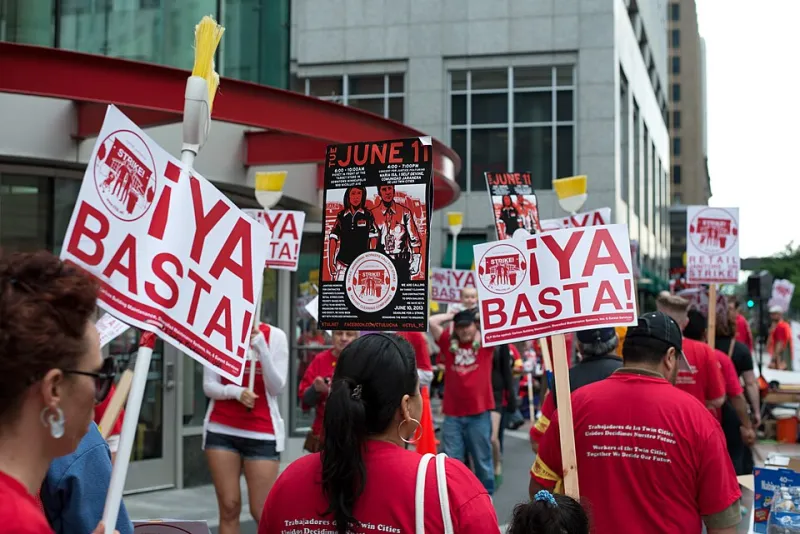
Photo: Fibonacci Blue, CC BY 2.0, via Wikimedia Commons
Something has shifted in the break rooms and stockrooms of America. Over the past several years, workers at some of the country's most recognizable low-wage employers — Amazon warehouses, Starbucks stores, Dollar General and Dollar Tree locations, Walmart, Trader Joe's, REI, and a rolling wave of fast-food chains — have filed for, won, and fought to sustain union elections at a pace that would have seemed implausible a decade ago. The National Labor Relations Board's own caseload tells the story: union election petitions surged dramatically beginning in fiscal year 2022, reaching levels the agency had not seen in roughly a decade, with a striking share driven by retail and food service workers rather than the traditional manufacturing strongholds of labor's past.
The Math That Built This Moment
The organizing wave did not emerge from nowhere. It is the product of a brutal economic squeeze with clear numbers behind it. Inflation peaked at a four-decade high of 9.1 percent in June 2022, according to the Bureau of Labor Statistics, with grocery and rent inflation hitting the lowest-paid workers hardest — because necessities consume a larger share of their paychecks. Meanwhile, corporate profitability in retail and food service recovered swiftly from the pandemic, and major low-wage employers returned billions to shareholders through buybacks and dividends even as entry-level wages lagged the cost of living.
Workers did the same arithmetic executives did, and reached a different conclusion: if the company can afford it, so can we. That is the entire moral argument of the retail organizing wave, and it is difficult to rebut on its own terms.
Why This Is the Decade's Most Important Labor Story
For forty years, the story of American labor was decline — deindustrialization, right-to-work laws, and the migration of jobs to sectors where organizing was nearly impossible. Service work was written off as unorganizable: high turnover, dispersed worksites, a workforce skewed young and part-time.
The current wave detonates that assumption. baristas and warehouse pickers have demonstrated that dispersed, high-turnover workforces can organize — using social media for coordination, strike funds for staying power, and the NLRB election process, imperfect as it is, as a foothold. If unions can crack retail and fast food, they can organize the entire growth sector of the American economy. If they cannot, the private-sector unionization rate — already below 7 percent per BLS data — will keep sliding toward irrelevance.
There is also a racial and gender justice dimension that progressives cannot ignore. Retail and food service workforces are disproportionately women and disproportionately workers of color. Organizing in these sectors is, in practical terms, organizing the workers the twentieth-century labor movement left behind. The wage premium that unions deliver — historically estimated in the range of 10 to 15 percent for comparable workers — would flow disproportionately to people the economy has systematically underpaid.
The Other Side of the Ledger
The strongest counterargument deserves a fair hearing. Skeptics note that union dues cost money that low-wage workers need, that unionization can slow individual advancement, and that some newly organized units have struggled to win their first contract — a well-documented vulnerability when employers resist bargaining in good faith. Others argue that tight labor markets, not unions, are the real wage driver, pointing to the rapid nominal wage growth of 2021–2023.
These points have weight. But they answer the wrong question. A hot labor market is temporary and reversible; a union contract is durable and enforceable. The failure mode of unionization — a stalled contract — is real, but it is a failure of law, not of workers: an employer's lawful ability to drag out bargaining is a policy choice Congress made and could unmake. And the dues objection dissolves on contact with the arithmetic of a first contract that raises pay and adds protections workers currently lack entirely.
What's Actually at Stake
Center the humans: the single mother stocking shelves at a dollar store in rural Ohio, the twenty-two-year-old running a fast-food drive-thru in Phoenix, the warehouse picker in the Inland Empire. These are the workers who were declared 'essential' in 2020 and 'replaceable' in 2021. The organizing wave is their answer to that whiplash — and its success or failure will determine whether the next decade of American work looks like shared prosperity or managed decline.
Watch the political landscape, too. Public approval of unions sits near its highest point in decades — around 70 percent in Gallup's long-running survey — even as union density remains near historic lows. That gap between sympathy and membership is the terrain on which this fight will be decided, alongside legislative questions like the PRO Act, which would penalize employer union-busting, and state-level battles over public sector bargaining.
The verdict: the workers stocking America's shelves have announced that essential is a wage category, not a compliment — and the rest of the economy should decide quickly which side of that fight it stands on.
Note: This is opinion journalism. Union election counts, approval ratings, and wage figures cited reflect widely published data from the NLRB, BLS, and Gallup as generally reported; readers should verify the most current figures.