Stolen Hours, Vanishing Wages: The Employer Crime Wave Nobody Is Prosecuting
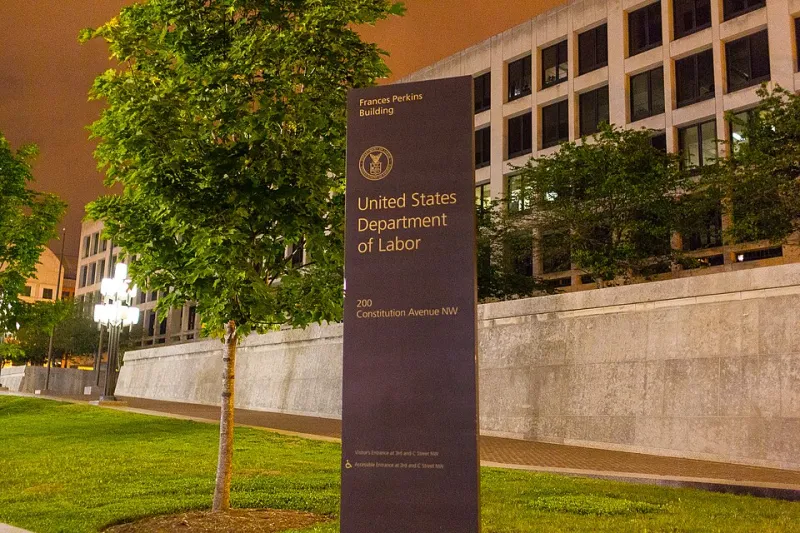
Photo: US Department of Labor, CC BY 2.0, via Wikimedia Commons
Imagine a crime that costs American workers an estimated $50 billion annually — more than robberies, burglaries, and motor vehicle theft combined, according to research by the Economic Policy Institute. Now imagine that the perpetrators face minimal criminal exposure, pay fines that amount to a rounding error on their quarterly earnings reports, and are rarely required to make their victims whole. That is not a hypothetical. That is wage theft in the United States in 2025, and it is happening at industrial scale.
Wage theft takes many forms: employers who simply don't pay workers for hours logged, managers who require staff to show up early or stay late off the clock, companies that misclassify employees as independent contractors to sidestep minimum wage and overtime obligations, and franchises that skim tips or make illegal deductions from paychecks. Each of these practices violates federal and state labor law. Most go unpunished.
A Regulator Without Teeth
The Wage and Hour Division of the Department of Labor is the primary federal agency responsible for enforcing the Fair Labor Standards Act. As of recent budget cycles, it employs roughly 800 investigators responsible for overseeing more than 165 million workers across approximately 11 million workplaces. Do the math: that is one investigator for every 200,000-plus workers. The agency's staffing levels have not meaningfully recovered from cuts that began in the 1980s, and the current political environment offers little reason for optimism about reinvestment.
The result is a system built on complaint-driven enforcement — meaning that unless a worker comes forward, files paperwork, and endures the bureaucratic gauntlet, the violation simply doesn't exist in any official record. For workers living paycheck to paycheck, many of whom are undocumented immigrants or are employed in at-will states with minimal job security, filing a complaint against an employer is not a neutral act. It is a gamble that can cost you the job you can't afford to lose.
When the Wage and Hour Division does act, the penalties rarely sting. Employers found in violation are typically required to pay back wages — the money they already owed — plus an equal amount in liquidated damages. There is no meaningful deterrent premium. A company that steals $2 million in wages over three years and is caught might be ordered to pay $4 million. That sounds significant until you realize the company kept the money, interest-free, for years, and faced zero criminal liability in the vast majority of cases.
Misclassification: The Legal Fiction That Costs Workers Everything
Among the most pervasive mechanisms of wage theft is worker misclassification. By labeling employees as independent contractors, companies in sectors from gig delivery to construction to domestic care offload payroll taxes, eliminate overtime obligations, deny workers access to unemployment insurance and workers' compensation, and strip them of the right to organize under the National Labor Relations Act.
The gig economy has normalized this arrangement to the point where many workers don't recognize it as exploitation. Platforms like DoorDash and Uber have spent hundreds of millions of dollars lobbying against reclassification legislation — most infamously in California, where Proposition 22 in 2020 effectively bought a carve-out from AB5, the state's landmark gig worker protection law. The message from capital was unambiguous: the rules that apply to everyone else do not apply to us, and we will spend whatever it takes to keep it that way.
Beyond gig platforms, misclassification is rampant in construction, agriculture, janitorial services, and home health care — industries that disproportionately employ Black, Latino, and immigrant workers. The Economic Policy Institute estimates that misclassification costs affected workers tens of thousands of dollars annually in lost benefits and wage protections, while simultaneously depriving state and federal governments of billions in tax revenue.
The Human Cost Behind the Statistics
Aggregate figures are useful, but they flatten what is, in practice, a deeply personal violation. Consider the home health aide who works 12-hour shifts but is paid for eight because her employer insists the time she spends helping a client eat breakfast is not "skilled care." Or the restaurant worker whose manager texts him to come in an hour before his shift starts but clocks him in at the scheduled time. Or the warehouse worker told she must attend a mandatory safety meeting before her shift — unpaid, of course.
These are not edge cases. A 2009 survey of low-wage workers in Chicago, Los Angeles, and New York — still one of the most comprehensive of its kind — found that 26 percent of workers had been paid less than minimum wage in the previous week, 76 percent of those who worked overtime were not paid the legally required overtime rate, and 70 percent who had experienced a pay violation did not complain to their employer or a government agency, primarily out of fear of retaliation. There is no reason to believe conditions have materially improved in the intervening years.
The Strongest Counterargument — and Why It Falls Short
Defenders of the status quo argue that heavy-handed enforcement burdens small businesses operating on thin margins, that many violations are inadvertent compliance errors rather than deliberate theft, and that the market will ultimately discipline bad actors as workers vote with their feet. These arguments deserve engagement, not dismissal.
It is true that small businesses face genuine complexity navigating federal and state labor law. It is also true that not every violation is malicious. And yes, some workers in tight labor markets do have leverage.
But this framework collapses when confronted with the evidence. Wage theft is most prevalent in industries where workers have the least leverage — low-wage, high-turnover sectors where desperation, not choice, keeps people in bad jobs. The "inadvertent error" defense is difficult to sustain when the same employer commits the same violation across hundreds of workers over multiple years. And the market-discipline argument requires a level of worker mobility and information asymmetry correction that simply does not exist for a 55-year-old home health aide in rural Mississippi.
The question is not whether enforcement imposes costs. Of course it does. The question is who bears those costs — workers who are robbed, or employers who profit from the robbery.
What Accountability Would Actually Look Like
Progressive labor economists and worker advocates have articulated a clear agenda: dramatically expand the Wage and Hour Division's budget and investigator workforce; shift toward proactive, industry-wide investigations rather than complaint-driven case-by-case enforcement; increase civil penalties to levels that actually deter violations rather than merely remediate them; pursue criminal referrals in cases involving systematic, knowing violations; and pass the Protecting the Right to Organize Act, which would strengthen workers' ability to collectively bargain for the wages they are owed.
Several states — California, New York, and Washington among them — have moved in this direction with stronger enforcement mechanisms and higher penalties. The results suggest that robust enforcement does not kill jobs; it raises the floor for everyone.
At the federal level, the political will to treat wage theft as the serious crime it is has been inconsistent at best, and the current administration's posture toward labor regulation offers little encouragement.
What This Signals
Wage theft is not a side issue. It is a window into the fundamental power imbalance at the heart of the American labor market — one in which capital writes the rules, underfunds the referees, and pockets the difference. Until enforcement resources match the scale of the problem, and until penalties are calibrated to deter rather than merely inconvenience, the theft will continue.
A society that prosecutes shoplifters with more vigor than it pursues employers who steal billions from the people who built their businesses has made a choice — and it is long past time to make a different one.